"...and to explain so complex a man as Harry by the artless division into wolf and man is a hopelessly childish attempt. Harry consists of a hundred or a thousand selves, not two. His life oscillates, as everyone's does, not merely between two poles, such as the body and the spirit, the saint and the sinner, but between thousand and thousands."
"Man designs for himself a garden with a hundred kinds of trees, a thousand kinds of flowers, a hundred kinds of fruit and vegetables. Suppose, then, that the gardener of this garden knew no other distinction than between edible and inedible, nine-tenths of this garden would be useless to him. He would pull up the most enchanting flowers and hew down the noblest trees and even regard them with a loathing and envious eye. This is what the Steppenwolf does with the thousand of flowers of his soul. What does not stand classified as either man or wolf he does not see at all. And consider all that he imputes to "man"! All that is cowardly and apish, stupid and mean--while to the wolf, only because he has not succeeded in making himself its master, is set down all that is strong and noble."
- from Steppenwolf, by Hermann Hesse
Tuesday, August 16, 2011

Monday, August 15, 2011
The Hawkline Monster
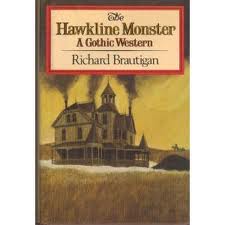
I think The Hawkline Monster ties with In Watermelon Sugar for my favorite Brautigan novel so far. Brautigan’s gothic western masterpiece follows the exploits of Greer and Cameron, two Oregon hitmen hired to kill a monster that lives in ice caves beneath a Victorian house in the middle of nowhere. Their employers are the strange Miss Hawklines—twin sisters as eerily hard to pin down as the house itself. The sisters spend their time trying to perfect The Chemicals, their father’s unfinished experiment he was working on when he went missing, which presumably has something to do with the monster beneath the house. If Greer and Cameron can take care of their little problem, they might be able to get along nicely without any more distractions.
Surreal, dark, creative, and wonderfully sinister, The Hawkline Monster makes me want to time travel back to the beginning of the 20th century, name myself Magic Child, and see the world through eyes acquainted with the strange.
Tuesday, August 2, 2011
Words Worth Quoting
“Everybody was lying to the FBI and CIA, sir. They were all afraid of punishment for various activities forbidden by our laws. No variation or permutation on their stories will hang together reasonably. Each witness lied about something, and usually about several things. The truth is other than it appeared. In short, the government, being an agency of punishment, acted as a distorting factor from the beginning, and I had to use information-theory equations to determine the degree of distortion present. I would say that what I finally discovered may have universal application: no governing body can ever obtain an accurate account of reality from those over whom it holds power. From the perspective of communication analysis, government is not an instrument of law and order, but of law and disorder.”
- from The Golden Apple, by Robert Shea and Robert Anton Wilson
Wednesday, July 27, 2011
Trout Fishing with Richard Brautigan

How to describe Trout Fishing in America? How to describe any of Richard Brautigan’s works? The closest working definition I can come up with is this: the mutant offspring of a booze-swilling novel and a poem strained through a mystic’s pajamas with the dark and sunny side of the American Dream alternating days as nanny. And that still isn’t sufficient.
Brautigan is brilliant. When I say that I’m referring to all of his books, but, for now, I think I’m better off to take each one individually, and right now Trout Fishing in America gets to enjoy the attention. It’s so short. And simple. And while an occasional plot appears from one fishing trip to the next, there largely is no plot. Every chapter is a short, simple, fragmented view of a particular moment or train of thought that in some way reveals a truth of America.
There is no way to sufficiently describe what the book is about because of its experimental style and resistance to categorization, but I’ll try to light a match over it so we can at least make out the outlines. Trout Fishing in America is mostly about just that, trout fishing in America. Brautigan gives accounts of various trout fishing trips he’s gone on throughout his life, some when he was young, and some once he is older, married, and has a child. I don’t know to what degree these accounts are fictionalized, but, at least from my perspective, they seem to have some basis in real life experience for the author. There’s the quick story of the Kool-Aid wino. There’s the character, Trout Fishing in America Shorty, probably the funniest character in all the novel. And there’s mayonnaise.
These are the kinds of things that pop up from one chapter to the next. If the exceedingly short length of each chapter (typically around two pages) and the beautiful employment of language did not already give it away, perhaps the jump from one topic to another as one chapter closes and the next begins (with the only thread of unity usually being the voyeuristic peek into America’s cognitive outhouse) will make it clear: each chapter is a prose poem.
Altogether, Trout Fishing in America is Richard Brautigan’s meditation on America—what it is, where it’s going, and how it’s not just a place but a buddy that’s along for the ride with each and every person. Whether he intended it as a main focus or not, Brautigan also managed to simultaneously undermine and reevaluate the novel form, and not in a bad way.
Friday, July 15, 2011
Recent Reads, New Buys, and Upcoming Reviews
I’m slow to post on here lately, but the next week or two should see more action. In the last couple of weeks I’ve read Clifford D. Simak’s novella, The Big Front Yard, and three books by Richard Brautigan: Trout Fishing in America; The Pill versus the Springhill Mine Disaster; and In Watermelon Sugar. By the end of the weekend I’ll at least have a little something up on Simak’s novella. In addition to all the Brautigan books I just finished, I read Willard and His Bowling Trophies a couple months ago, so I’ll have tons to say about him. For now, it is enough to say that Richard Brautigan has tied with Tom Robbins for my favorite writer’s slot.
I’ve also got a lot of books queued that I bought used one place or another: Albert Goldbarth’s The Kitchen Sink; Lewis Thomas’s The Lives of a Cell; John Berryman’s Dream Songs; Harlan Ellison’s Approaching Oblivion; Samuel R. Delany’s The Fall of the Towers; Carol Emshwiller’s Report to the Men’s Club and Other Stories; and Philip Jose Farmer’s Down in the Black Gang and Other Stories.
Right now I am going back and forth between Robert Anton Wilson’s Illuminatus! books and Grant Morrison’s The Invisibles, and I should have reviews up on them sometime after those on Clifford D. Simak and Richard Brautigan.
Tuesday, June 28, 2011
Heinlein Makes Twins a Little Less Creepy...or Maybe the Other Way Around

Robert A. Heinlein’s Time for the Stars is an entertaining romp through the dark of space and the labyrinths of time. Twin brothers Thomas Paine Leonardo da Vinci Bartlett and Patrick Henry Michelangelo Bartlett are recruited by the mysterious Long Range Foundation for a project that may take the whole of their lives to see through. In fact, this touches on the one characteristic that must be inherent in any experiment before the LRF will even consider touching it—it must take generations to produce any results.
The particular project Tom and Pat sign on for initially seems to be one of exploration. One twin goes aboard a ship bound for distant star systems while the other stays on Earth. Together, they function as a telepathic communication team that allows for instant transmission of information between ship and home planet. The implications at first seem obvious—radio signals take years to span the light years separating a ship and Earth, and thus are of no use by the time they are received. Telepathic twins like Pat and Tom eliminate this problem. As the ship and its crew streak through space, making pit stops at strange planets and eventually returning home, the brothers realize that the implications of their ability are far more important than dependable communication—they can tear down the walls of time altogether!
Saturday, June 25, 2011
More Conjuring From Samuel R. Delany

Whereas Triton seems a cognizant, introspective maze caught up in self-contemplation, I found Nova to be much the opposite. It is a futuristic tale of revenge featuring Holy Grail undertones, tarot card broadcasts, a man with a sun rattling around in his cranium, star-flung gypsies, and a much larger inventory of brain-charming images and ideas.
Lorq Von Ray is a starship captain racing the wealthy and powerful Prince and Ruby Red to the source of enough Illyrion to change the economies of entire star systems. But what is Illyrion? Is it a superheavy element which in grams can power entire cities for years? Or is it something more elusive and hard to define?
To carry out his mission, Von Ray enlists the help of the cyborg studs, the Mouse, Katin, Lynceos, Idas, Sebastian, and Tyy. Once pulled in by the quietly leviathan personality, there is no escaping his gravitational field until the uncertain end.
This novel is first and foremost a space adventure, but Delany manages to make plenty of social commentary. The cyborg studs raise questions of the relationship of man to machine, mythology-draped society blurs the line between science and mysticism, and Katin, the anachronistic novelist that has yet to write a word, presents the creative writing process from a totally new perspective.
Overall, this was an incredibly entertaining novel. The last few scenes with Prince and Ruby Red were some of the best I have read since Alfred Bester’s The Stars My Destination.
Subscribe to:
Posts (Atom)